
Looking for an easier way to manage your app’s backend? Learn how Supabase simplifies database


In June 2026, Québec’s Ministère du Travail released L’intelligence artificielle au travail : guide d’accompagnement pour une intégration responsable (Artificial intelligence at work: a guide for responsible integration). The document draws on a consultation held in late 2024 and early 2025 with several organizations, as well as on the opinion of the Comité consultatif du travail et de la main-d’œuvre (CCTM), adopted unanimously by the employer and union representatives who sit on it.
The guide’s goal is to help workplaces benefit from the advantages of AI while limiting its negative effects on work and on people. It’s meant as a reference point to help organizations take their first steps toward a thoughtful use of artificial intelligence.
We chose to summarize it for a simple reason: our mission is to train people to build products powered by AI, that integrate AI, or even to create artificial intelligence algorithms themselves. Responsible integration of the technology therefore starts with a solid understanding of its the issues involved. Whether you’re on the usage side (integrating an AI tool into your operations) or the development side (building AI products or features), understanding these issues is the starting point for using AI in a way that genuinely benefits teams, and society more broadly.
The guide is built around five broad principles, recognized internationally, that should guide the development, deployment and use of AI in the workplace:
The CCTM’s central message: humans must remain at the heart of decision-making. AI should stay a tool for support, not a mechanism that replaces human judgment, expertise and responsibility.
It’s from these five principles that the guide analyzes the concrete advantages of AI at work, as well as the challenges and risks that come with its integration.
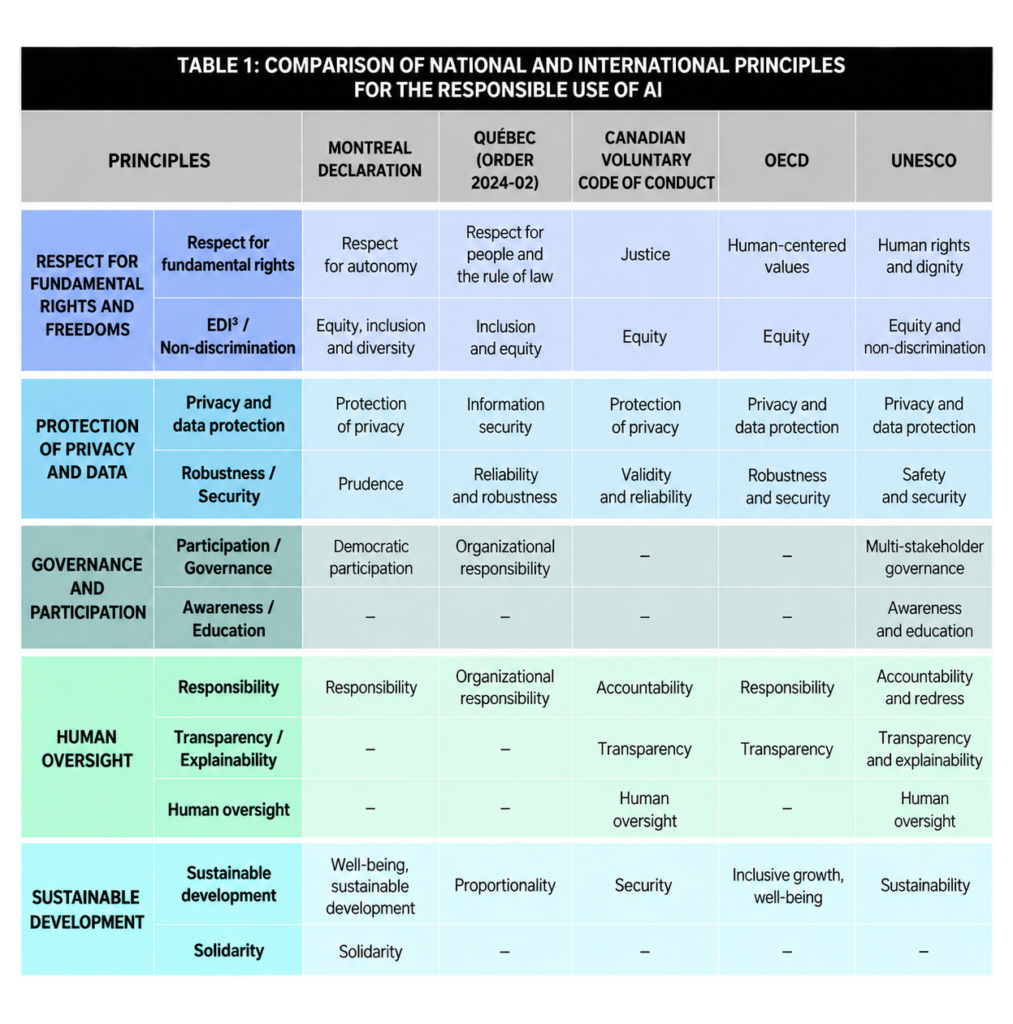
The challenge here is algorithmic bias. An AI system used in recruitment, performance evaluation or career management can reproduce or amplify existing inequalities. The CCTM recommends particular vigilance at the design, training and use stages of these tools.
The advantage, when that vigilance is in place: real support for decision-making. Teams get faster access to relevant, contextualized information, free up time for higher-value tasks, and gain more autonomy.
The challenge is data security and confidentiality. Using AI in the workplace can involve collecting and processing sensitive data about employees, with heightened risks of surveillance, profiling or data leaks.
The advantage of rigorous data governance: better organization and security of information, which reduces errors, improves the reliability of analyses and strengthens the protection of information.
The challenge is the ambiguity around accountability and liability. When an AI-influenced decision causes harm, who is responsible? This ambiguity can be a problem in critical situations like performance evaluations or scheduling, and can weaken traceability and recourse mechanisms.
The advantage of clear governance, including the participation of workers and their representatives: a real boost to creativity and innovation, with better information flow and greater team engagement.
The challenge is technological dependency. AI systems can present unpredictable failures, and excessive trust in them can weaken workers’ critical judgment, especially when decisions are made without human validation.
The advantage of rigorous human oversight: an improvement in productivity and operational efficiency, for example through predictive analysis to anticipate breakdowns or better plan maintenance.
The challenge is psychosocial risk. AI integration can intensify work, raise performance expectations or create a sense of constant surveillance, generating stress and job insecurity.
The advantage of an approach centred on human decisions: an improvement in well-being, reduced exposure to dangerous situations, and safer working conditions.
The companion guide, Pratiques pour passer à l’action (practices for taking action), turns the first guide’s principles into practical steps: establishing a clear strategy and governance, managing data, testing systems and assessing risks, planning deployment, building employees’ awareness and involving them in the process, and monitoring how AI is used and how it affects the workplace over time. These practices span an AI system’s entire life cycle and can be adapted to each organization’s circumstances. Read the full guide (in French)
Training is part of that process. Pratiques pour passer à l’action highlights the importance of helping employees understand AI’s uses, limitations and risks. The aim is to give everyone the grounding they need to use these technologies thoughtfully and safely, in keeping with their organization’s values and practices, without expecting every employee to become an AI specialist.
Our training helps people navigate this change at a level that fits their skills and role. Some need to use AI in their day-to-day work; others need to automate processes, integrate AI into products or develop AI systems. At Le Wagon, building these skills also means understanding the responsibilities involved: preventing bias, protecting sensitive data and preserving human judgment.
Our programs cover several of the skills that support this progression:
Our business training catalogue also offers courses and learning pathways tailored to each team’s needs, job functions and level of AI maturity.
This guide from the Ministère du Travail gives a common framework to everyone in the world of work. For us, it’s a useful reminder: the best way to make the most of AI, whether as a user or as a builder, is to understand what it really changes, for people, not just for productivity.
Want to build AI skills ? Discover our bootcamps.
Looking for an easier way to manage your app’s backend? Learn how Supabase simplifies database

Struggling to make data impactful? Let me show you how AI data visualization tools and

What’s behind all the hype about data science? We asked Lead Teacher João to explain

Coding can lead to very different careers in tech. Ellen, who did Le Wagon with

My role is developer in Javascript. It shows that though the course is Ruby, we

Giovanni grew up in Geneva where he still lives. Digital native, he has always been